Fred and Loathing on The Internet
Welcome to the public web log of Fred Lambuth
Popular Tracks from 2026-10-31
The Long Telegram, the Longer Biography
2026-Oct-31
The management has asked that more blog content be produced on a regular basis. They are irate that so much has been provided to the creative staff at fredlambuth.com yet there is so little output to show for it. The top brass have voiced complaints about the level of initiative being shown among the employees. There have also been threats of funding being withheld.
They say all the creature comforts available should be reason alone for much more blog posts. The (incredibly soothing to use mechanical) keyboards should be typing all the time, joyfully mind you. The (fancy and articulate) colored pencils should be pressed to paper at the same rate with the same amount of cheer.
Sure, there was quite a lot of grumbling among the crew about being asked to ‘work harder’. They really hate work, even when it’s not hard. This imploring from the top brass for increased production of our artistic creations has been heard loud and clear, or so they tell me. Will this resounding reception to the new orders go anywhere? We’ll find out in the long run. Here’s to a good start. A thousand year publication reich!
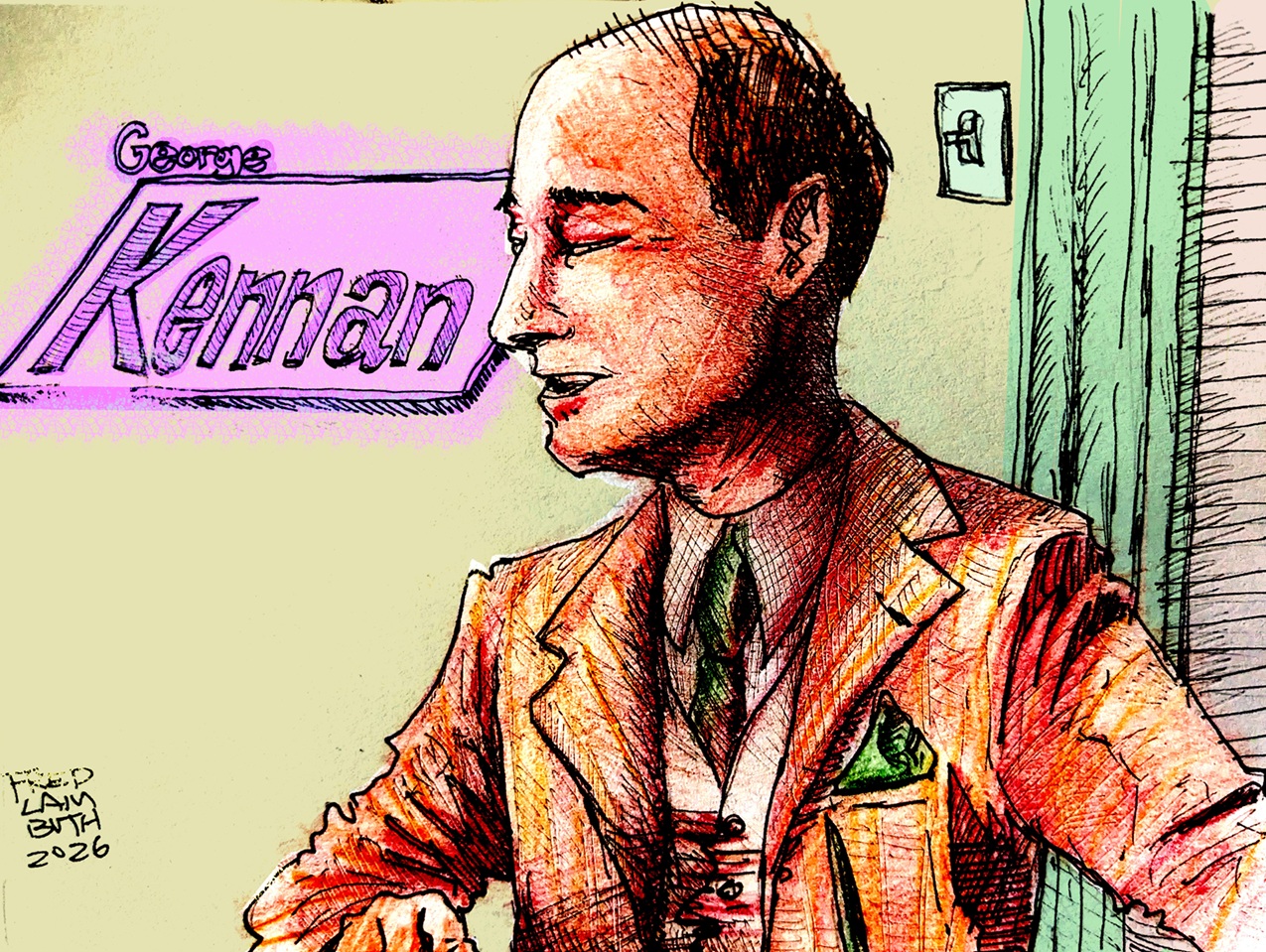
The first blog post after this bold step forward will be one gabbing about a 1000 page biography of George F. Kennan, a man who definitely put out a lot of written copy. Thousands of words per day. The guy was oozing phrases and bon mots to write down. What was learned from reading this biography, George F. Kennan: An American Life by John L. Gaddis (published in the mid 2010s), was that Kennan wrote all the time. The dude was a prolific fountain of letters, essays, poems, and eventually full length histories. I suppose that was to be expected for a man that history would essentially remember as man of letters. If he were to be remembered holistically.
An unusually long diplomatic telegram is what put his name in the public sphere. It also was the largest claim to fame he would have throughout his long not-so-storied career. He wrote so much after that telegram first credited to Mr. X. Those long winded writings even won awards. Pullitzers! Nobels! Kennan was collecting the whole academic elite triple crown. Despite all those accolades and accomplishments, the bulk of his fame is being the guy who wrote that long telegram.
This accomplishment was so grand that it dwarfs the rest of his life’s work. His total lifespan opining on US foreign policy in some capacity is something I personally had no idea about until reading this book, despite being a student of political history. Kennan was a name known to any student of American political history. It is attached to one big word that defined geopolitics for decades. He did have a minor part in several subsequent US foreign policy episodes, even helping start the professional espionage efforts of the CIA. If his name did show up in all those other books I read on all that CIA semi-legal covert shenanigans, I suppose had glossed over that fact as an interesting yet trivial tidbit.
That big idea Kennan came up with was called ‘containment’. That big yet single-word concept is the grand strategy for the WW2 victors to deal with their ersatz wartime ally, the United Soviet Socialist Republics (USSR). When I learned the fact that containment was the product of one single guy, it became a single historical fact. Once given time to actually process that idea, it struck me as odd that one person could be attributed as the originator of an easy to grasp idea. Does ‘containment’ need an author? Wasn’t containment just basic political science?
Rumours of me being a Cold War buff are greatly exaggerated. Sure I read a lot of books about the unfought war between the USA and the USSR in the latter half of the twentieth century. Books about the hidden war between the CIA and the KGB. Books about the rivalries between the submarine commands. I’ve pored over long political science tomes about the influence war fought in the third world. The science fiction aesthetic I try to pioneer in my artwork I like to describe as ‘ColdWarPunk’. The video game that I have most recently spent an embarrassing amount of hours playing focuses on the Gottadamerung battle that would take place on the central plains of Germany between the NATO and Warsaw Pact armies waiting at the Fulda Gap. So, yes, there are a lot of things I know about what the US imperialist swine were doing to the godless commie russkies.
What I knew about those crepuscular days of The Cold War, before the name itself was coined and the second world war had just finished, was actually pretty extensive upon further inspection. Decolonization is another big reading topic for me. The immediate years right after are the big starts to a lot of decolonization efforts by force or by writings. Also I had a spell of reading books about the official recriminations drawn up immediately after WW2 ended. The legal efforts to deal with the unique horrors that war brought upon the world. I do remember contemporary interest in the tribunal made to prosecute the Empire of Japan waned quickly as soon as the first tenets of The Cold War entered public discussion.
What was not there in my bucket of knowledge about the Cold War was an examination of what were the political expectations of the only true victors of WW2, who both reached the rank of global superpowers. I did not put much thought on how each side expected the other to behave once the war did not bind them together as allies. It seemed a little obvious to me. The alliance between the West and The Soviet Union was a wartime bargain that would almost turn into a third war the moment Germany collapsed. This could be grand strategy video game playing influencing my mode of thought. Both sides wanted to get as much as they could from the spoils of victory, and knew they had to watch their back.
Apparently a lot of people thought the Soviets would be a welcome player in the post-war international community. That was a little bit of a surprise when I read about Kennan having to convince high level operators in the American government that the Soviets will not change their foreign policy simply because we helped their anti-German war effort so much. What was not so surprising to learn from reading this big fat Kennan biography was how often the US foreign service is lacking in personnel intimate with foreign cultures. The appointed diplomats that Kennan worked for in his early career thought that negotiation was negotiation, so why would arguing with the Russians be any different? Knowing that, the idea that most Americans were not aware of the goings on in Russia, now or in the historical past, does make the naive notion of possible cooperation between the Soviets and capitalist economies dissipated that surprise.
On the other side of the problem of what the US to do with its recent global war ally were people that saw only an empire on the warpath, willing to keep sacrificing soldiers for their conquests. That was half true. It was a viewpoint that was less surprising than the Soviets ingratiating themselves in global organizations. What was wrong about it, as stated by Kennan, was that the Soviets were very, very reluctant to actually fight. They were an empire that wanted to grow but they didn’t want to fight unless they were absolutely sure they could win. The Soviet leadership really cared about their prestige, or ability to project it. They were selling a new ideology and could not afford to look like a weakling. Especially after winning the largest armed conflict the world has ever seen.
Kennan, a keen student of Russia and its role as the epicenter of geopolitics because of its location on the plains that connects all of the Eurasian landmass, and of Marxist thought, and just from his personal experiences living among the Russians, correctly posited that the Russians were not going to strike first. The war was going to be ‘cold’. The best thing we could do was ‘contain’ the USSR. There was a third way between sheepish peace offerings and preparing for full scale war.
Seeing this concept as obvious is likely from my modern lens. Zeitgeists are very hard to capture after they are over. Reading history books about events that took place during my lifetime can feel ‘wrong’ compared to my lived experience. That repeated experience is how I can see containment being such a bold concept in 1946. Everybody, the public and the leaders, have been battered by a global war going on for years and years. I could only guess how it felt rather than what I’ve read about in books. There are likely ideas now swimming around me that will end up as ideas compressed into slogans or single terms in the history books. I suppose the nominees I can immediately fathom are ‘War on Terror’, ‘woke’, and ‘MAGA’.
This book was as enjoyable as the material could allow for. I did breeze through the first and last hundred pages. I did not find George Kennan himself to be that interesting of a person. Learning about his childhood, family, or golden years was not thrilling. Hearing about his grandfather being involved in Russia was one nugget from his early years that was enriching once the story got up to his role brokering US thinking with Russian thinking.
His biography was well travelled and prolific. The close up facts that come from reading one thousand pages about one man have shown me that had he not gotten the one-time bonanza of notoriety from writing the Long Telegram, I would not have had the interest to read a thousand page book about his life. I wanted a big biography about his times, not his life. I did find enough chunks of personal Cold War history in this book. That meaty inner center was a Forrest Gump script of the big names of Cold War policy.
It would seem that eventually Kennan found a way to burn every bridge he had as a higher up in the US Foreign Service. Academics and publishing suited him better where he could speak his mind without having somebody having to take his word seriously. He had decades of career success up until his death at the age of 101. There is much to admire about his life. Yet I feel if there was not that Long Telegram, I would just as likely to have read his biography as I would one about McGeorge Bundy. And I am not planning to even look up if he has one.
Add Comment